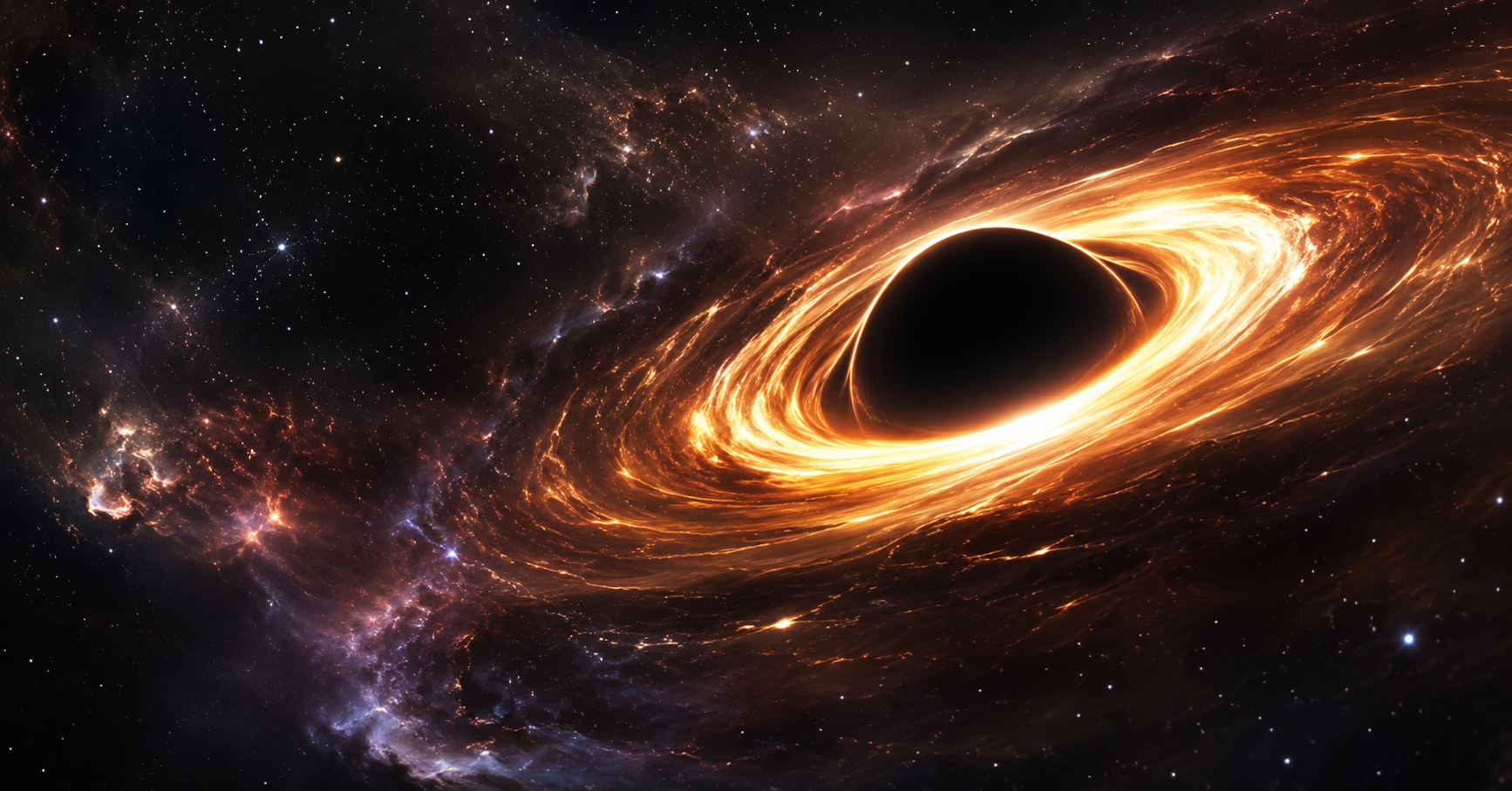
Space is full of mysteries, but few are as fascinating as black holes. To understand, imagine a place in the universe where gravity is so strong that nothing can escape it, not even light. This makes black holes invisible, not because they are empty, but because they trap everything that comes too close.
To explain what is a black hole in simple words, it helps to think of space as a stretched fabric. When a very massive star dies, it collapses under its own weight and bends this fabric so deeply that it creates a point of no return. This is how a black hole is born, and it begins its life silently in the vastness of space.
The Story of a Dying Star and What Is a Black Hole in Simple Words
Long before a black hole exists, there is a massive star shining brightly in space. This star spends millions or even billions of years burning fuel, producing light and heat. But every star has a life cycle, and eventually, it runs out of energy.
The idea behind what is a black hole in simple words becomes clearer when we follow this star’s final moments. As the star loses its fuel, gravity starts to take control. The outer layers explode in a powerful event called a supernova, while the core collapses inward.
The Collapse Begins
When the core shrinks, it becomes extremely dense, squeezing all its mass into a tiny point, where gravity becomes so strong that normal physics can no longer describe its behavior.
Birth of an Invisible Giant
This tiny point creates such strong gravity that it forms a black hole, pulling in nearby matter and even light, making it invisible and extremely powerful in space.
Inside the Mystery of a Black Hole
A black hole is not a hole in the traditional sense. It is an object with enormous gravity packed into a very small space. Scientists study by observing how it affects nearby stars and light.
Once something crosses the boundary of a black hole, known as the event horizon, it cannot escape. Even the fastest thing in the universe, light, gets trapped.
The Event Horizon
This is the point where escape becomes impossible, marking the edge of the black hole, known as the event horizon where gravity is so strong that nothing can return once crossed.
The Invisible Nature of Black Holes

Black holes cannot be seen directly because they do not emit light. Instead, scientists detect them by observing how they influence surrounding objects.
Understanding what is a black hole in simple words becomes easier when you realise that we see its effects rather than the object itself.
Watching the Effects
Stars near a black hole move in unusual patterns, revealing its presence through their altered orbits, extreme speeds, and gravitational disturbances caused by the black hole’s intense pull.
Time and Space Around a Black Hole
One of the most surprising effects of black holes is how they change time and space. According to physics, gravity can slow down time, and near a black hole, this effect becomes extreme.
To explain what is a black hole in simple words, imagine time slowing down the closer you get to it, almost as if the universe is stretching itself.
Time Dilation
Time moves slower near strong gravity compared to far away in space, an effect known as gravitational time dilation, where intense gravity causes time to pass more slowly relative to weaker gravitational regions.
What Would Happen If You Fell In
Falling into a black hole is one of the most extreme ideas in science. While it sounds dramatic, it helps us understand its power.
If someone were to approach a black hole, they would experience something called spaghettification, where gravity stretches objects into long shapes.
Stretching Effect
The difference in gravity between your head and feet would stretch you apart due to extreme tidal forces, where stronger gravity at one point pulls more intensely than at another.
Different Types of Black Holes
Black holes come in different sizes. Some are small, while others are massive and exist at the centres of galaxies.
The study of includes understanding these different types and how they form.
Stellar Black Holes
These form from collapsing stars and are relatively smaller, typically known as stellar black holes, created when massive stars run out of fuel and collapse under their own gravity.
Supermassive Black Holes
These exist in the centre of galaxies and can be millions of times larger than the Sun, known as supermassive black holes, which influence the motion of stars and the structure of entire galaxies.
Black Holes in the Universe
Black holes play an important role in shaping galaxies. They influence the movement of stars and even affect how galaxies grow.
Learning what is a black hole in simple words also helps us understand the structure of the universe itself.
Galactic Influence
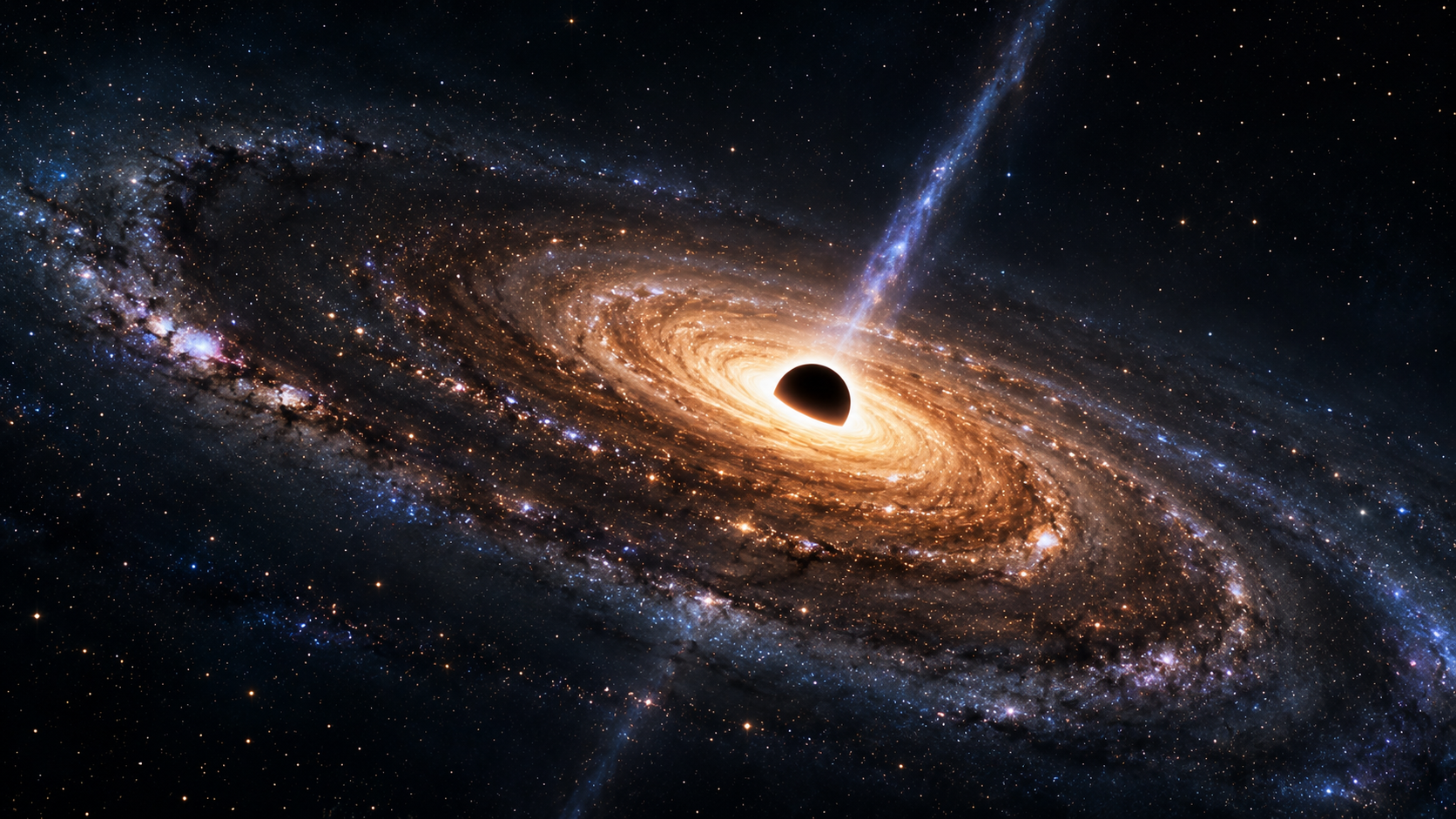
Supermassive black holes can control entire star systems around them through their immense gravitational pull, influencing the orbits of nearby stars, gas, and dust on a galactic scale.
Can Anything Escape a Black Hole
One of the most common questions is whether anything can escape a black hole. According to science, once something passes the event horizon, it cannot come back.
The concept clearly shows that escape is impossible beyond a certain point.
Hawking Radiation
Some theories suggest black holes may slowly lose energy over extremely long periods through a process called Hawking radiation, where they emit tiny amounts of radiation and gradually evaporate.
How Scientists Study Black Holes
Even though black holes are invisible, scientists use advanced telescopes and technology to study them.
Understanding what is a black hole in simple words today is possible thanks to radio telescopes and space observatories.
Observing Light Bending
Scientists detect how light bends around a black hole’s gravity by observing gravitational lensing, where the intense gravity warps space and distorts the path of nearby light.
Black Holes and Modern Science
Black holes are not just mysterious objects; they are also important for testing theories of physics.
The study of what is a black hole in simple words helps scientists explore gravity, space, and time in extreme conditions.
Testing Einstein’s Theory
Black holes provide strong evidence for general relativity by confirming predictions about extreme gravity, spacetime curvature, and the behavior of light and matter near massive objects.
Why Black Holes Matter
Black holes help us understand how the universe works on a large scale. They are key to unlocking many cosmic mysteries.
The explanation shows how one object can change our understanding of space itself.
Cosmic Evolution
Black holes influence how galaxies form and evolve over billions of years by regulating star formation, shaping galactic structures, and affecting the movement of gas and dust through their immense gravitational and energetic effects.
Final Thoughts
Black holes remain one of the most fascinating topics in science. Although they are invisible, their effects are powerful and far-reaching.
To summarise what is a black hole in simple words, it is a region in space where gravity is so strong that nothing can escape it, formed from the collapse of massive stars.
Ultimately, it helps us appreciate the complexity and beauty of the universe, reminding us how much there still is to discover beyond our planet.
Frequently Asked Questions (FAQs)
What exactly is a black hole?
A black hole is a region in space where gravity is so strong that nothing, not even light, can escape from it, formed when massive stars collapse under their own gravity into an extremely dense point in space.
How do black holes form?
They form when a massive star collapses at the end of its life, often after a supernova explosion, compressing its core into an extremely dense object under intense gravity.
Can we see a black hole directly?
No, black holes are invisible, but scientists detect them by observing their effects on nearby stars and light, such as unusual orbits, gravitational lensing, and high-energy radiation from surrounding matter.
What happens if something falls into a black hole?
It gets stretched and compressed due to extreme gravity in a process sometimes called spaghettification, where intense tidal forces pull objects apart as they approach a black hole.
Are all black holes the same size?
No, they range from small stellar black holes formed by collapsing stars to supermassive ones found at the centres of galaxies, which can contain millions or even billions of times the Sun’s mass.
Do black holes last forever?
Some theories suggest they may slowly lose energy over extremely long periods through a process called Hawking radiation, a quantum effect where black holes can emit tiny amounts of radiation and gradually evaporate.